Challenge
People with developmental disabilities are a group that often has lower physical activity and at the same time challenges such as overweight, diet and body awareness. Many also find it difficult to find motivation and attachment to the established sports life.
Experience also points to the fact that classic offers do not always affect citizens' needs and interests.
The question was therefore:
How can we — based on citizens' own wishes and everyday life — design a sports offer that motivates people with developmental disabilities to move more?
Process and solution
The work was based on a civic and investigative approach focusing on understanding what motivates the target group.
The initiative stems from the experience of the Special Olympics Sports Festival in Kolding and a collaboration with Parasport Danmark, which began in 2021. Here the foundation was laid for a systematic user survey, in which citizens — through questionnaires and dialogue with employees — contributed knowledge about what is perceived as meaningful and motivating.
The insights clearly showed that community and social relationships are stronger drivers than the activity itself — and that friends and social community have a big impact on whether you participate. This also shows in the fact that some activities which professionals expected would be attractive were opted out of by citizens.
At the same time, it was clear that practicalities are of great importance for participation. Data and dialogues indicated that:
On this basis, the solution was developed as a unified concept, where both motivation and everyday logistics are thought together.
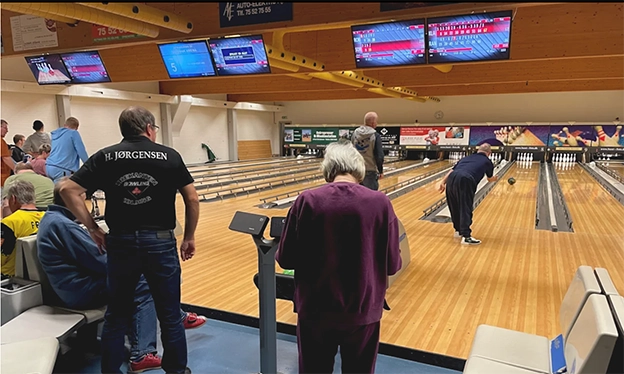
Today, Wednesday sports are a regular, weekly offer in SydbanKarena, where citizens meet one day a week for various activities such as bowling, handball and dancing. The activities take place simultaneously and in the same place, so that participants are part of the same community — regardless of the choice of activity.
The offer is supported by a strong organisation around cooperation between housing offers, associations, workplaces and the municipality. Common transport solutions have been established — including direct driving from work — and the activities are an extension of everyday life. In addition, during the start-up phase, the participant payment was removed to reduce financial barriers.
The Wednesday sport has been developed as a lasting effort that is continuously adjusted through dialogue between stakeholders, annual meetings and close coordination across the board — with a focus on both maintaining what works and continuously developing the development offer.
Results
Wednesday sports have led to a marked increase in the number of citizens with developmental disabilities doing sports -- with a doubling of participants.
At the same time, increased well-being and quality of life are experienced among participants, where both movement and social relationships play a central role. The efforts have strengthened the connection to sports life and created an increased focus on movement in everyday life.
Wednesdagsisportten thus helps to address the documented inequality in health and shows how sport can be a concrete entrance to a healthier life for a target group with complex challenges.
Wednesday's sports show how a citizen-centered and investigative approach -- combined with strong cross-cutting collaboration and a focus on practical barriers -- can translate into solutions that work in practice.